
Do You Need Approval for a Retaining Wall in NSW?
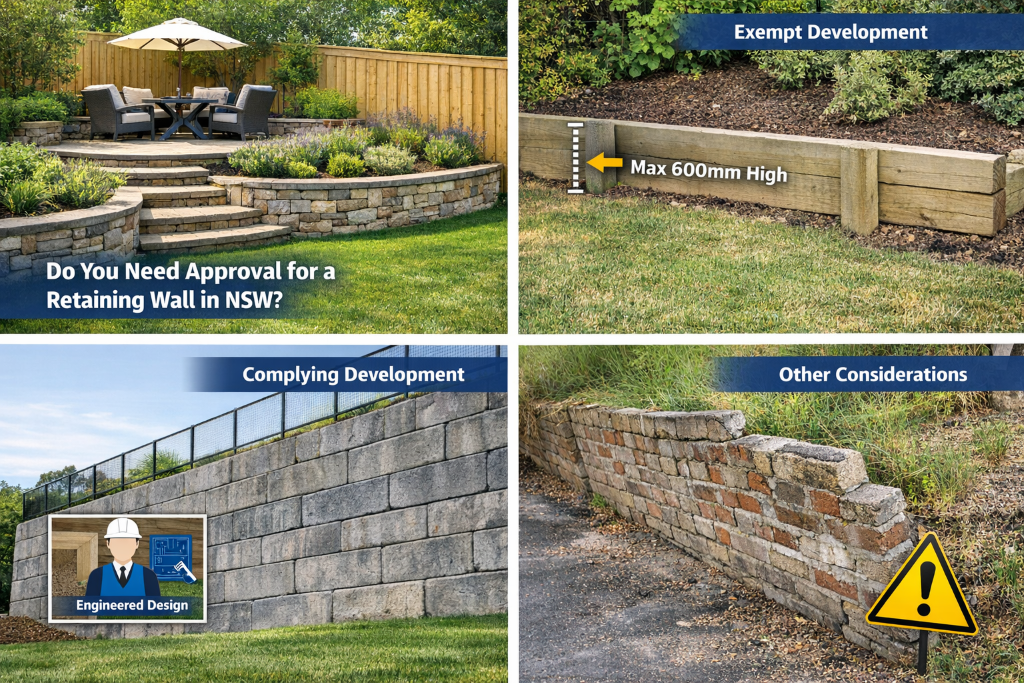
The question may be more complicated than you thought
Exempt Development, Complying Development and Development Applications Explained
Retaining walls are common features in residential properties. They are used to manage level changes, stabilise soil and create usable outdoor space.
A question that frequently arises for homeowners is:
Do I need council approval to build or replace a retaining wall?
In New South Wales the answer depends on the planning pathway available under the State Environmental Planning Policy (Exempt and Complying Development Codes) 2008, often referred to as the Codes SEPP.
Depending on the circumstances, a retaining wall may be:
Exempt Development – no planning approval required
Complying Development – approved by a private certifier
subject to a Development Application (DA) through council
Understanding which pathway applies depends largely on the height, location and purpose of the retaining wall.
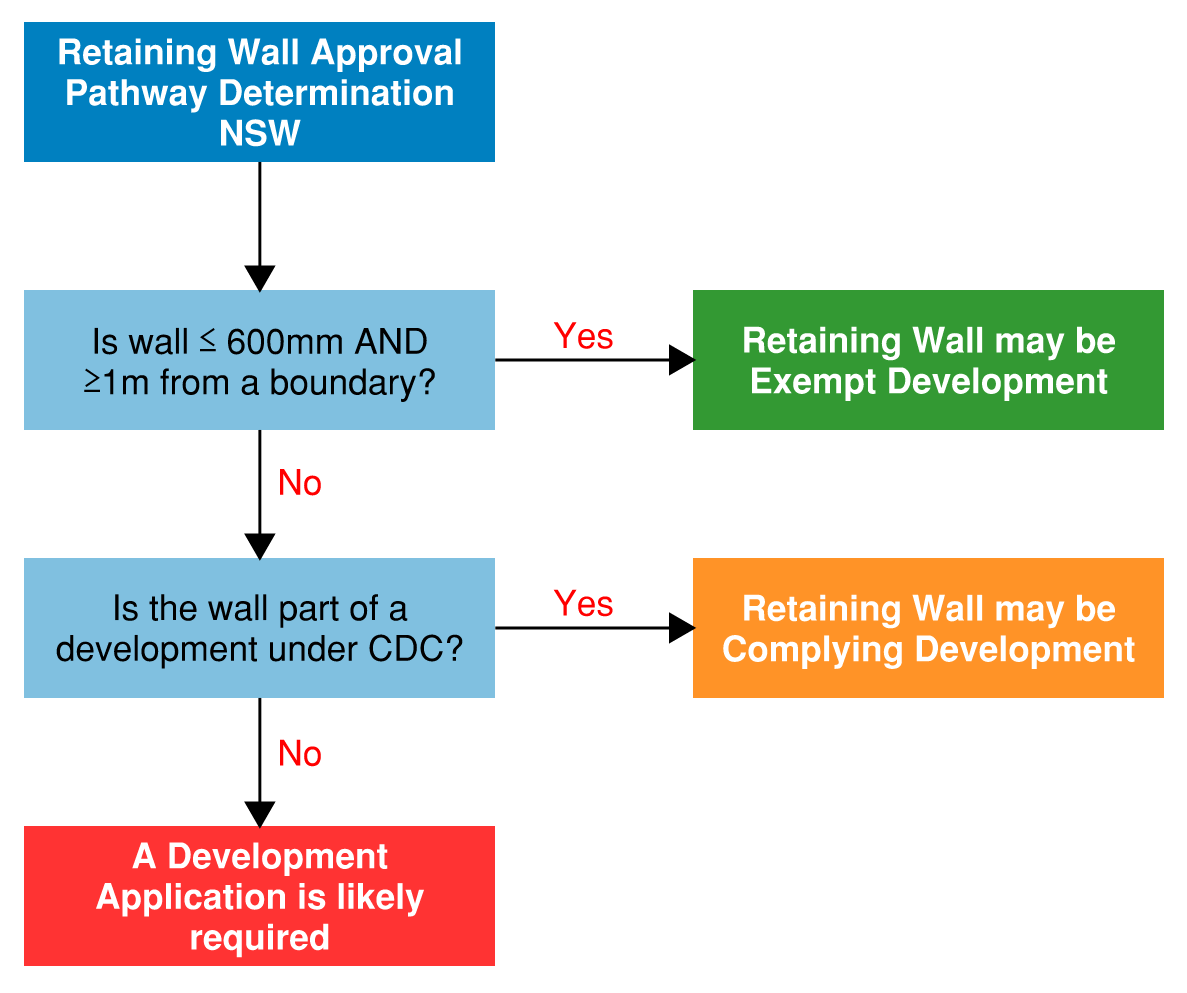
Determining the retaining wall approval pathway in NSW
Let us look at some further details on this and understand what is at play here.
What Is the Codes SEPP and Why Does It Exist?
The Codes SEPP was introduced to make approval of low-impact and routine development faster and simpler.
Instead of requiring every small project to go through a full council development application process, the policy establishes a set of pre-approved development standards.
If a proposal meets these standards it can proceed through simplified pathways:
Exempt Development
Very small works that meet strict criteria can be carried out without planning approval.
Complying Development
Projects that meet a defined set of planning and design standards can be approved by a private certifier instead of council.
If a proposal does not meet either pathway, it will generally require a Development Application (DA) to be assessed by the local council.
For most homeowners considering a retaining wall, the key question is whether the wall qualifies as Exempt Development or Complying Development.
Can a Retaining Wall Be Exempt Development?
The Codes SEPP allows some retaining walls to be built as Exempt Development, provided a number of strict conditions are met.
These provisions fall under Subdivision 15 – Earthworks, retaining walls and structural support.
To qualify as exempt development, the retaining wall must generally meet the following criteria:
excavation or fill must not exceed 600 mm above or below existing ground level
the retaining wall must be no more than 600 mm high
the wall must be located at least 1 metre from any lot boundary
retaining walls must be separated from other retaining walls by at least 2 metres
the works must not redirect surface water or groundwater onto neighbouring land
adequate drainage must connect to the existing stormwater system
What This Means for Homeowners
While exempt development sounds straightforward, these controls mean relatively few retaining walls qualify.
Two requirements in particular often prevent retaining walls from being exempt:
Height
The wall must be 600 mm or less in height.
Many residential retaining walls are taller than this.
Distance from boundaries
The wall must be located at least 1 metre from a property boundary.
In residential areas retaining walls are often built on or very close to boundaries, which means they cannot meet this requirement.
Because of these limitations, many residential retaining walls cannot proceed as exempt development.
Interpreting the 600 mm Cut or Fill Rule
The exempt development provisions also limit cut or fill to 600 mm relative to existing ground level.
There is some debate about how this rule should be interpreted.
One interpretation is that it limits the earthworks carried out during construction.
Another interpretation is that it regulates the final change in ground levels, meaning temporary excavation required to construct the wall would not necessarily prevent the development from being exempt.
Because the legislation does not clearly define this point, councils often adopt the more conservative interpretation.
Can a Retaining Wall Be Approved as Complying Development?
If a retaining wall does not qualify as Exempt Development, it may still be approved as Complying Development.
For most residential properties this is assessed under the Housing Code, which forms part of the State Environmental Planning Policy (Exempt and Complying Development Codes) 2008. Specifically, Clause 3.30
Complying Development allows certain residential projects to be approved by a Private Certifier rather than requiring a full council Development Application.
However, there are some important limitations.
Retaining walls are usually only complying development when they form part of other residential works.
For example, retaining walls may be approved under the Housing Code where they are associated with:
the construction of a dwelling house
additions or alterations to a house
garages, sheds or other detached structures
earthworks required to support residential development.
In these situations, the retaining wall is assessed as part of the overall development, rather than as a standalone structure.
For other types of developments (not residential), reference to the specific clauses within the scope of the relevant Complying Development Codes shall be made.
Limits on Excavation Near Boundaries
The Housing Code sets limits on how deep excavation can occur depending on how close the work is to neighbouring properties.
Measured from existing ground level:
excavation within 1 metre of a boundary must not exceed 1 metre depth
excavation 1–1.5 metres from a boundary may be up to 2 metres deep
excavation more than 1.5 metres from a boundary may be up to 3 metres deep
These limits are designed to reduce the risk of impacts on neighbouring land.
Engineering Certification Is Required
Where earthworks exceed 600 mm, the Codes SEPP requires the excavation or fill to be supported by a retaining wall or structural support that has been designed and certified by a professional engineer.
The retaining wall must:
be structurally capable of resisting lateral soil pressures
include appropriate drainage
be designed so that it does not redirect water onto neighbouring land
be installed in accordance with engineering design or manufacturer specifications.
This ensures that larger earthworks are supported by appropriate structural design.
Separation Between Retaining Walls
Where multiple retaining walls are used, the Housing Code requires them to be separated by at least 2 metres horizontally.
This requirement prevents tiered or stepped retaining walls from being constructed too closely together without additional assessment.
Situations Where Complying Development May Not Be Available
Even if the wall meets the engineering requirements, complying development may not always be available.
This often occurs where:
the retaining wall is a stand-alone project, not associated with other residential works
the site is affected by heritage, flood or bushfire constraints
excavation limits under the Housing Code are exceeded
the development does not meet other planning standards in the Codes SEPP.
In these situations, the retaining wall will generally require a Development Application (DA) to be assessed by council.
A Practical Takeaway for Homeowners
For residential properties, the complying development pathway can often simplify the approval process when retaining walls are associated with larger residential works such as building a house or undertaking major landscaping.
However, if a retaining wall is being constructed as a standalone project, it may not fall neatly within the Housing Code provisions and may require council approval.
Seeking advice from a Private Certifier or Council early in the design process can help determine whether the retaining wall can proceed under complying development or whether a Development Application will be required.
When a Development Application Is Required
If a retaining wall does not qualify as Exempt Development or Complying Development, the works will generally require a Development Application (DA) to be lodged with the local council.
Council assessment considers broader planning issues such as:
drainage impacts
stability of adjoining land
potential impacts on neighbouring properties
visual or environmental impacts.
Each Council has specific requirements around what is permissible and what information is required in order for Council to make a determination on the Development Application. It is also important to note that the approval of a Development Application does not permit construction, a Construction Certificate is still required.
For small, straightforward projects a combined Development Application and Construction Certificate Application is often submitted, in an attempt to streamline the process.
While only Council can assess and approve a Development Application, a Construction Certificate can be assessed by either Council or a Private Certifier.
Replacing an Existing Retaining Wall
One situation that often causes confusion is the replacement of an existing retaining wall.
Many homeowners assume that replacing a deteriorated wall with a similar structure will automatically be exempt development.
However, the Codes SEPP does not contain a specific exemption for replacement works.
This means the new wall must still meet the relevant criteria for exempt or complying development.
In some cases, this can result in a retaining wall that has existed for decades requiring approval in order to be replaced.
We’ve discussed some of the challenges and issues around, as well as the frustration it can cause, previously. Retaining Walls, Development Applications and the Growing Complexity of Planning Approvals — reeca Consultants.
Final Thoughts
Retaining walls are common structures in residential properties, but the planning pathway for approval is not always obvious.
For homeowners the key factors that determine whether approval is required include:
the height of the retaining wall
how close it is to property boundaries
whether it forms part of other residential development
whether it meets the criteria for exempt or complying development.
Understanding these controls early can help avoid delays and ensure retaining walls are designed and constructed in accordance with both planning and engineering requirements.
It is always recommended to get advice that is specific to your situation by talking to a Private Certifier or your local Council.
Other Considerations
While planning approval is important, there are several practical issues homeowners should also consider when constructing or replacing a retaining wall.
Stability of nearby structures
Retaining walls often support soil that may also support fences, driveways, buildings or neighbouring land. Removing or excavating around an existing wall can potentially undermine these structures if the works are not carefully managed.
Condition of existing walls
If a retaining wall is leaning, cracked or showing signs of movement, it may indicate the structure is approaching failure. Where safety is a concern, it is advisable to seek advice from a structural or civil engineer.
Drainage
Proper drainage behind a retaining wall is critical. Water build-up behind a wall can significantly increase pressure and is a common cause of failure.
Neighbouring properties
Retaining walls near property boundaries can affect neighbouring land, including drainage and support of adjoining ground levels. Discussing the works with neighbours early can help avoid disputes.
Although retaining walls may appear simple, they play an important role in supporting soil and protecting surrounding structures, and should be designed and constructed with appropriate care.
Disclaimer
The views and analysis expressed in this article are those of the author and are provided for general informational purposes only. They do not constitute planning, engineering or legal advice.
The discussion is based on the author’s interpretation of the State Environmental Planning Policy (Exempt and Complying Development Codes) 2008 and related planning provisions as they existed at the time of publication. Planning legislation and its interpretation may change over time, and individual site conditions can significantly affect approval requirements.
Readers should seek advice from a qualified planner, certifier, engineer or relevant authority before relying on this information for any specific development or project.
FAQ
How High Can a Retaining Wall Be Without Council Approval in NSW?
In most residential situations, a retaining wall can only proceed as exempt development if it is no more than 600 mm high and located at least 1 metre from the property boundary, along with meeting other requirements in the Codes SEPP.
Walls larger than this will usually require either complying development approval or a development application.
Can I Build a Retaining Wall on My Boundary?
Retaining walls located directly on a property boundary will generally not qualify as exempt development, as the exempt development provisions require a 1 metre setback from the boundary.
Depending on the circumstances, these walls may still be approved through complying development or a development application.
Do I Need an Engineer for a Retaining Wall?
Where retaining walls support earthworks greater than 600 mm, the Codes SEPP generally requires the structure to be designed and certified by a professional engineer to ensure it can safely resist soil pressures and manage drainage.
References
State Environmental Planning Policy (Exempt and Complying Development Codes) 2008