
Waterproofing an External Pavement? Sure, Why Not.
When NCC interpretation stretches beyond the building
Sometimes the hardest part of a project isn’t the engineering — it’s agreeing on what the code actually means.
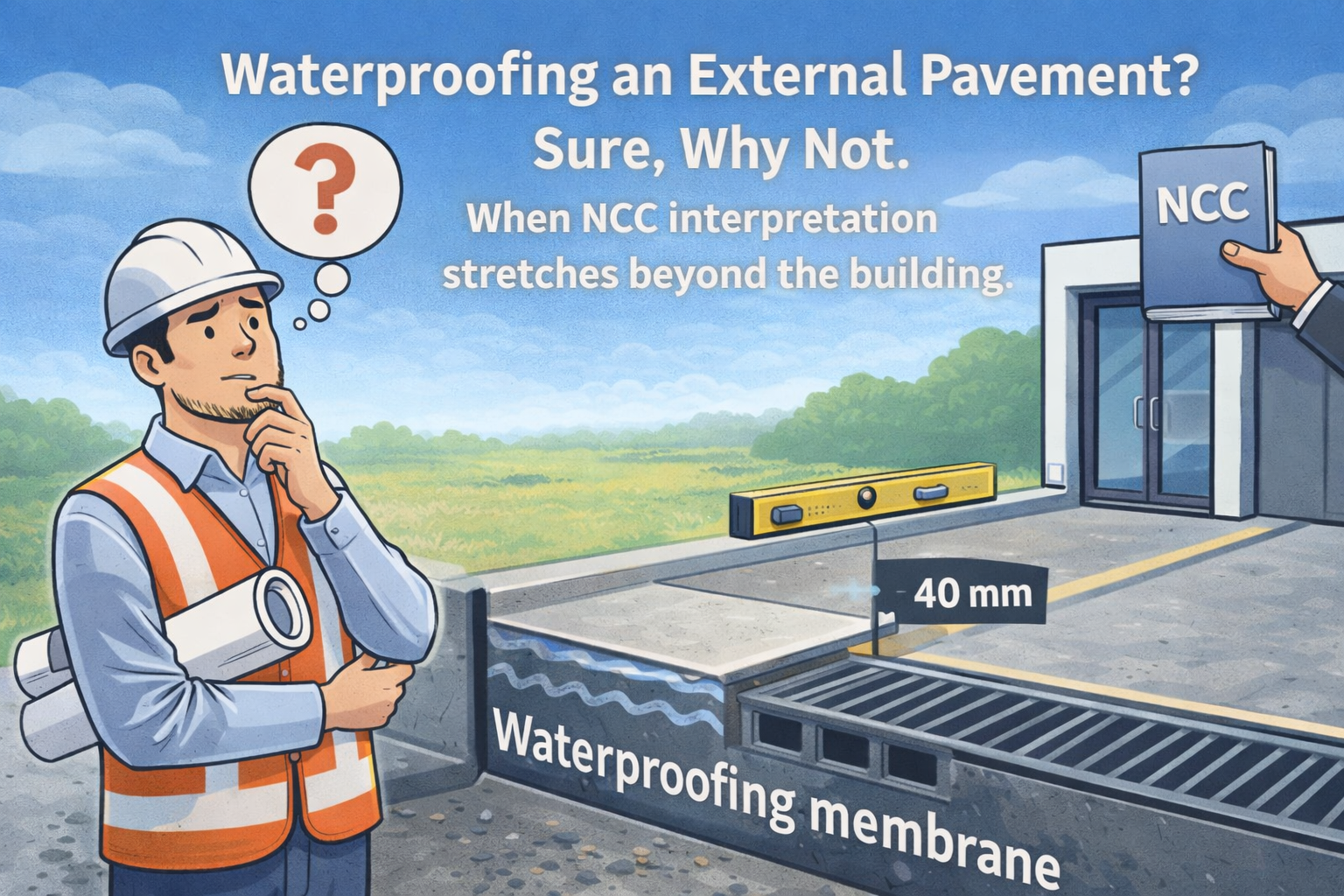
Anyone involved in building design will recognise the moment.
A project stalls — not because the engineering is difficult — but because the interpretation of a clause becomes the problem.
Recently we encountered exactly that situation with NCC Clause F1D5 – External Waterproofing Membranes.
At face value, the clause appears straightforward:
A roof, balcony, podium or similar horizontal surface part of a building must be provided with a waterproofing membrane…
Most practitioners read this as referring to elements of the building envelope — roofs, balconies and podium slabs.
But in our case, the clause was interpreted quite differently.
The Scenario
The project involved a typical accessible entry arrangement:
A 35 mm threshold ramp to comply with AS1428.1 accessibility requirements
External pavement graded 2% away from the building
Surface drainage directed toward a drain further away from the building
In other words, the pavement performs exactly as good external design should — water moves away from the building entrance.
However, the certifier interpreted “similar horizontal surface” to mean any horizontal surface, including the external pavement outside the building.
Under that interpretation:
The pavement was considered a “horizontal surface part of the building”
Waterproofing compliant with AS4654 was deemed necessary
Which implied the need for a 40 mm hob
Immediately the design was forced into conflict with AS1428.1 accessibility requirements, which limit threshold heights.
The solution proposed was to prepare a Performance Solution.
Not because the design failed to manage water.
But because of how the clause was being interpreted.
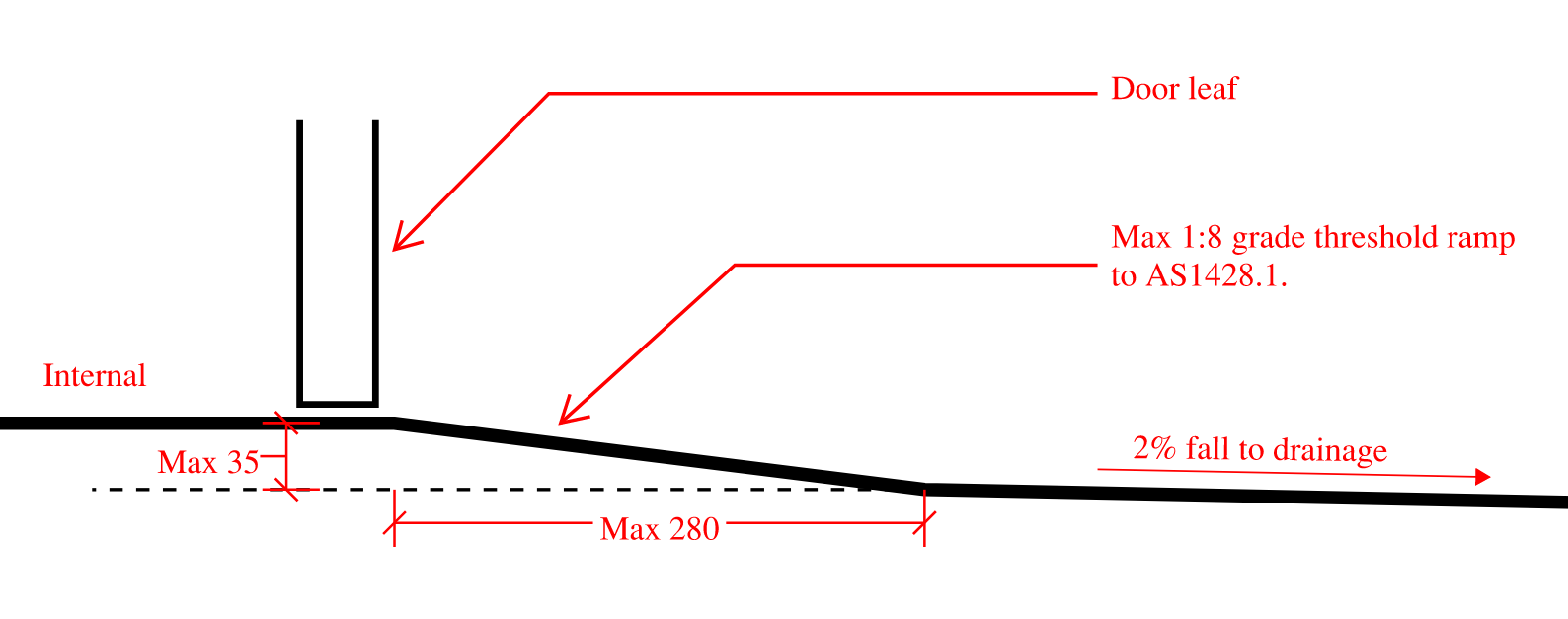
Accessible entry detail - water fall away from the building
A Clause That Provides Important Context
The interpretation becomes even harder to reconcile when Clause F1D2 – Application of Part is considered.
F1D2 states that F1D3 to F1D5 do not apply to a balcony, podium or similar horizontal surface part of a building where:
The flooring is timber decking or perforated flooring; or
The surface is located directly above ground
This is an important clue about the intent of the provisions.
If the NCC explicitly recognises that surfaces directly above ground may not require waterproofing, it reinforces that these clauses are concerned with protecting spaces below from water ingress.
This aligns with the elements listed in F1D5:
Roof
Balcony
Podium
Each of these typically protects occupied areas or building elements below.
External pavements are different.
They are generally managed through surface drainage design, not waterproofing membranes.
The Meeting
To discuss the issue, we met with the PCA and presented several arguments:
If the clause intended to apply to any horizontal surface, it would simply say so.
The pavement was not part of the building, but external ground adjacent to it.
The interpretation was not consistent with common industry practice.
None of these arguments changed the outcome.
The response was that the interpretation was a company-wide position, agreed collectively by the PCAs within the organisation.
Certification would not proceed without a Performance Solution.
A Broader Trend
This experience highlights something that appears to be becoming more common in the industry.
As organisations become more conscious of professional liability and commercial risk, there is a natural tendency toward increasingly conservative interpretations of the code.
From a risk management perspective, that approach is understandable.
But it also comes with consequences.
When conservative interpretations become standard practice, projects can experience:
Additional Performance Solutions
Increased consultant costs
Design constraints that were never intended by the code
Program delays
Ultimately those costs are borne by clients, project teams and the community.
The Risk of Being Too Risk-Averse
There is also a cultural element at play.
Within organisations, engineers and certifiers often understand when a conservative interpretation may not fully align with technical intent.
But challenging that position carries its own risk.
If someone pushes for a more balanced interpretation and something goes wrong later, the consequences can be significant.
So the safest internal position becomes the most conservative one.
Ironically, the collective result can be a system that is technically safe but operationally inefficient.
The Design Outcome
In this case, the physical design did not change.
The pavement still:
Falls away from the building
Directs water toward drainage infrastructure
Maintains accessible entry compliance
The only difference was the need to produce a Performance Solution report to justify something that is widely accepted as standard practice.
A Question for the Industry
Perhaps the more interesting question is not about whether an external pavement should be waterproofed.
It’s about how interpretation of the NCC is applied in practice.
In this case:
The design clearly managed water appropriately.
The slab fell away from the building.
Accessibility requirements under AS1428.1 were satisfied.
The certifier acknowledged that the design could be accepted through a Performance Solution.
Which raises a genuine question.
If a design clearly satisfies the performance intent of the NCC, should the PCA have the authority to reject a well-supported interpretation of the Deemed-to-Satisfy provisions?
Because when that happens, the outcome is not a different building.
The outcome is simply more process.
More documentation.
More reports.
More administration.
None of which change the physical performance of the design.
The Cost of Administrative Compliance
Performance-based codes were introduced to encourage engineering judgement and flexibility, not to create procedural hurdles.
Yet situations like this show how easily the system can drift toward administrative compliance rather than technical compliance.
When conservative interpretations are enforced without flexibility, the result can be:
More Performance Solutions
More consultant reports
More time spent documenting obvious outcomes
Ultimately these costs are absorbed by the project and the community.
Final Thought
The NCC relies on informed judgement from both designers and certifiers.
Most of the time that balance works well.
But when interpretation becomes rigid, even simple details — like an external pavement outside a doorway — can become unexpectedly complicated.
Which might leave some practitioners asking:
Are we solving engineering problems… or paperwork problems?